Wolf Oven Repair
Wolf Oven Problems, Sorted by Symptom: What to Check First
Most Wolf oven problems trace to a worn igniter or element, a drifting temperature sensor, a failing convection fan or the control board. Check power and gas, test with an oven thermometer at 350°F, note any code, and stop at any smell of gas.
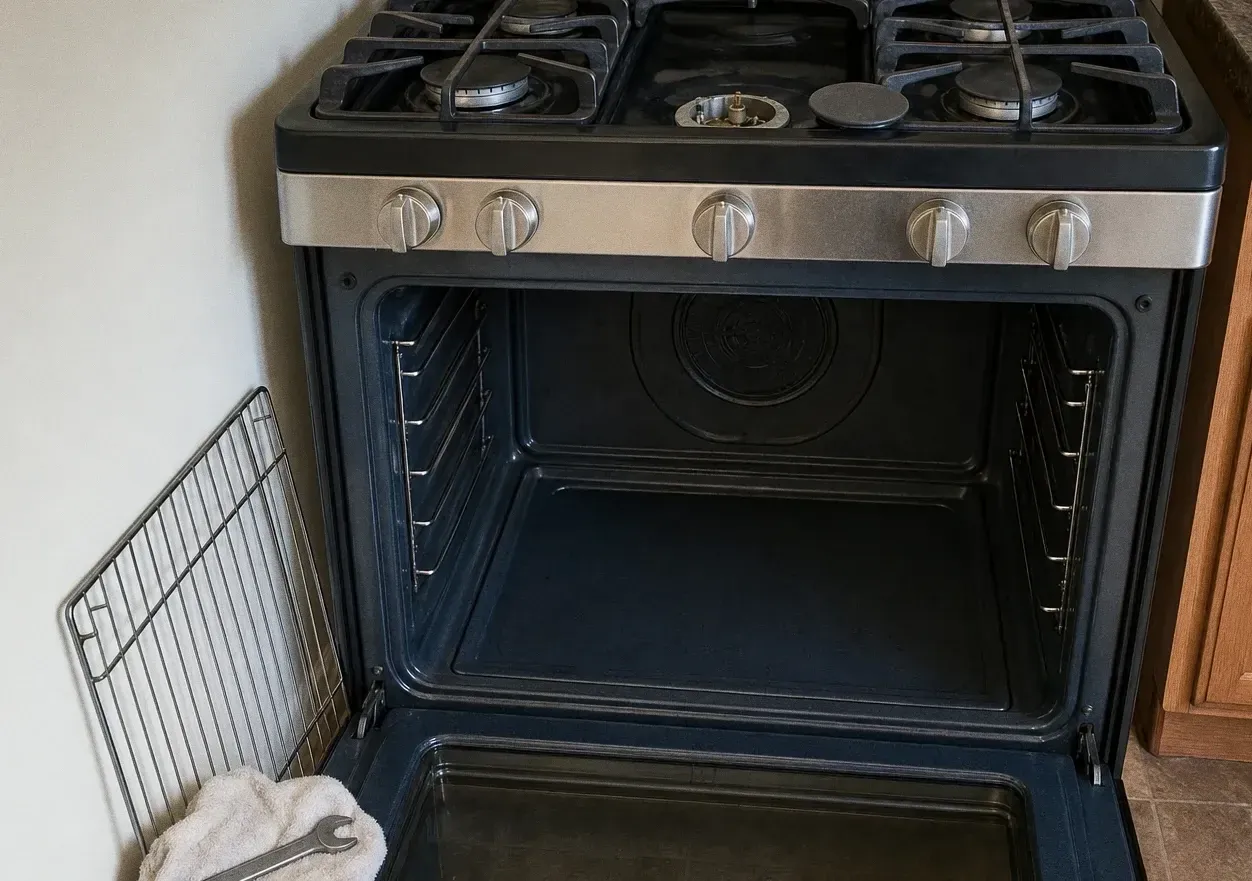
Most Wolf oven problems come from a short list of parts: the igniter or heating element that makes the heat, the temperature sensor that measures it, the convection fan that moves it, the door gasket that holds it in, and the control board that runs everything. Before anything else, rule out the simple causes. Confirm the breaker is on, confirm the gas shutoff behind a gas or dual-fuel range is open, and run a 20-minute test at 350°F with a separate oven thermometer on the middle rack. Write down any code or message on the display. If you smell gas at any point, stop right there and let a technician take over.
Wolf cooking equipment tends to show its age in a predictable order: the top burners first, because they get the hardest daily use, then oven heat and accuracy, then the electronics, and last the fans and door. This guide follows that order. Larger Wellesley kitchens often pair a Wolf range with a double wall oven, so note which appliance and which cavity is misbehaving before you call.
Gas safety comes before any troubleshooting
A gas range or rangetop has one rule ahead of all the others. If the kitchen smells of rotten eggs, do not light a burner, flip a switch or unplug anything. Leave the house and call the gas company’s emergency line from outside. A brief whiff in the second or two while a burner lights can be normal. An odor that lingers with every knob turned off is not.
Beyond that, keep owner checks to things you can see, wipe or switch: a knob, a burner cap, a spark electrode, a breaker. Removing panels, tightening gas fittings or sliding a heavy pro-style range out on its own gas line are not homeowner jobs.
Burners that click, will not light or burn yellow
Clicking with no flame, or clicking that carries on after the burner has lit, usually means moisture or boiled-over food near the spark electrode, or a burner cap sitting slightly crooked. Give a wet burner a few hours to dry, wipe the electrode and set the cap flat and centered. Our article on a Wolf burner that sparks and never catches walks through that sequence.
A lazy, yellow or lifting flame points to blocked ports or a misaligned cap. Clear the ports with a straightened paper clip rather than a toothpick, which can snap off inside. If one burner stays weak while its neighbors burn crisp and blue, or will not hold a gentle simmer, the valve or orifice behind it likely needs service.
The oven will not heat, or heats very slowly
A cold or painfully slow oven splits into two cases, depending on how it makes its heat.
Electric and dual-fuel ovens
Wolf wall ovens and the ovens in dual-fuel ranges heat with electric elements. Check the breaker first, since a tripped leg of a 240-volt circuit can kill the elements while the display stays lit. If power is fine, look for a bake or broil element that never glows, or one with a visible blister or break. A fault code at the start of preheat can also mean the temperature sensor is reading open, which stops the oven from heating at all.
Gas ovens with a glowing igniter
On an all-gas range that lights its oven with a hot-surface igniter, the igniter must get hot enough to open the safety valve before any gas flows. As it ages it still glows, just not hot enough, so you see an orange glow and no flame, or a flame that takes several minutes to appear. It is one of the most common gas-oven complaints, and the part sits behind panels that should stay in place unless a technician is removing them.
Wrong temperatures and a broiler that stays dark
Burned bottoms and long bake times send most people straight to the thermostat. Test before you blame it. Preheat to 350°F, wait another 20 minutes, then average three thermometer readings taken a few minutes apart, because every oven cycles around its setting. A steady offset of more than about 25 degrees is worth acting on. Many Wolf ovens accept a temperature offset in the settings menu; if the reading keeps wandering after an adjustment, suspect the sensor or the control.
A broiler that stays dark is its own problem. On an electric oven, select broil and look at the upper element after two or three minutes; it should glow evenly along its whole length. A dark section or a split sheath means it has failed. On an all-gas model the broiler has its own burner and igniter, so a healthy bake flame with no broil flame points there. An element that looks perfect yet never heats leaves the relay or control as the suspect, which is a technician’s job.
Controls, codes and a blank display
Electronic controls fail less often than igniters and elements, but they cause the most confusion. Rule out the features that only look like faults first: a control lock, Sabbath mode or a forgotten timer can make the panel ignore touches or keep the oven idle.
For a blank display, check the breaker, then do a full power reset by switching it off for about a minute and back on. That clears plenty of glitches left by a power flicker. Photograph any fault code before resetting, since it helps a technician arrive with the right part. A code that comes back after one reset is reporting something real. A touch panel that responds in patches, or registers the wrong command, usually needs the panel or the board replaced.
Fans, noises and the door
Most Wolf ovens have two fans, and only one is worrying when it keeps going. The cooling fan protects the electronics and often runs well after cooking ends; that is normal. A cooling fan that runs with the oven completely cold, or never runs, deserves a call.
The convection fan sits behind the back wall of the cavity. Grinding or scraping, a fan that stops in convection modes, or uneven results only on convection settings all point to the motor or the convection element.
Door trouble shows up as heat escaping at the top corners, a door that drifts open, or a lock that stays engaged after a clean cycle. Check the gasket for flattened or torn spots and make sure nothing is caught in a hinge. A door stuck shut after self-clean has its own routine, covered in our guide to a Wolf door that will not open after self-clean.
When to stop, and what repairs usually cost
Stop and call when there is any gas smell, when a breaker trips again after one reset, when you see scorched or melted wiring, or when the next step means taking off a panel. Our Wolf oven repair service covers Wellesley Hills, Wellesley Farms, Wellesley Square and Cambridge, and the number is (781) 371-8990. You pay $95 for the visit and a complete diagnosis, and that amount is deducted from the repair bill once you say yes to the work.
These are typical ranges, and the firm quote follows the diagnosis. Sensor replacement or calibration tends to fall between $130–$660. A new oven igniter or spark module usually lands at $280–$630, and burner valve or orifice work at $250–$1,060. Expect $310–$940 for a convection fan or motor, $210–$960 for door hinges, glass or seals, and $510–$1,590 for a control board or touch panel. A comparable new pro range costs many times more than any of these, so on an oven that is otherwise sound, repair is usually the better buy.
Still asked
Why is my Wolf oven broiler not working?
Usually the broil element has burned out or, on an all-gas model, the broiler igniter has grown too weak to light the burner. Set broil and look at the top of the cavity after two or three minutes. An electric element should glow evenly from end to end; a dark stretch or a split sheath means it has failed. If it looks intact and still stays cold, the relay or control feeding it needs a technician.
Is it normal for a Wolf oven fan to keep running after I switch the oven off?
Yes, for a while it is. The cooling fan protects the electronics and often keeps going until the cavity has dropped well below cooking heat, which can take some time after a long roast or a self-clean. It is only a concern if the fan runs when the oven is stone cold, or never runs at all.
How far off can a Wolf oven temperature be before it needs service?
A steady offset of more than about 25 degrees after a full preheat is worth acting on. Every oven swings above and below its setting as it cycles, so take three thermometer readings a few minutes apart and average them. Many Wolf ovens allow a temperature offset in the settings menu; if the reading keeps drifting after you adjust it, the sensor or control is the likely cause.
Can I reset a Wolf oven myself?
Yes, a power reset is safe and often clears a frozen display or a one-off code. Switch off the breaker that feeds the oven, wait about a minute, then switch it back on. Photograph any code before you do it. If the same code returns after one reset, stop resetting and book a diagnosis, because it is pointing at a real fault.
What does a Wolf oven repair usually cost?
It depends on the part, and the firm figure only comes after diagnosis. The visit itself is a flat $95, which is credited to the repair once you approve it. Typical ranges run $130–$660 for sensor or calibration work, $280–$630 for an igniter or spark module, $310–$940 for a convection fan, and $510–$1,590 for a control board or touch panel.