Wolf Oven Repair
Wellesley: The Self-Clean Cycle Ended and the Wolf Door Will Not Open
The door stays locked until the control reads the cavity cool, so start by waiting properly. Then separate locked from locked-and-dead, read the code as an observation rather than a part number, and on a paired installation compare the two cavities before you call.
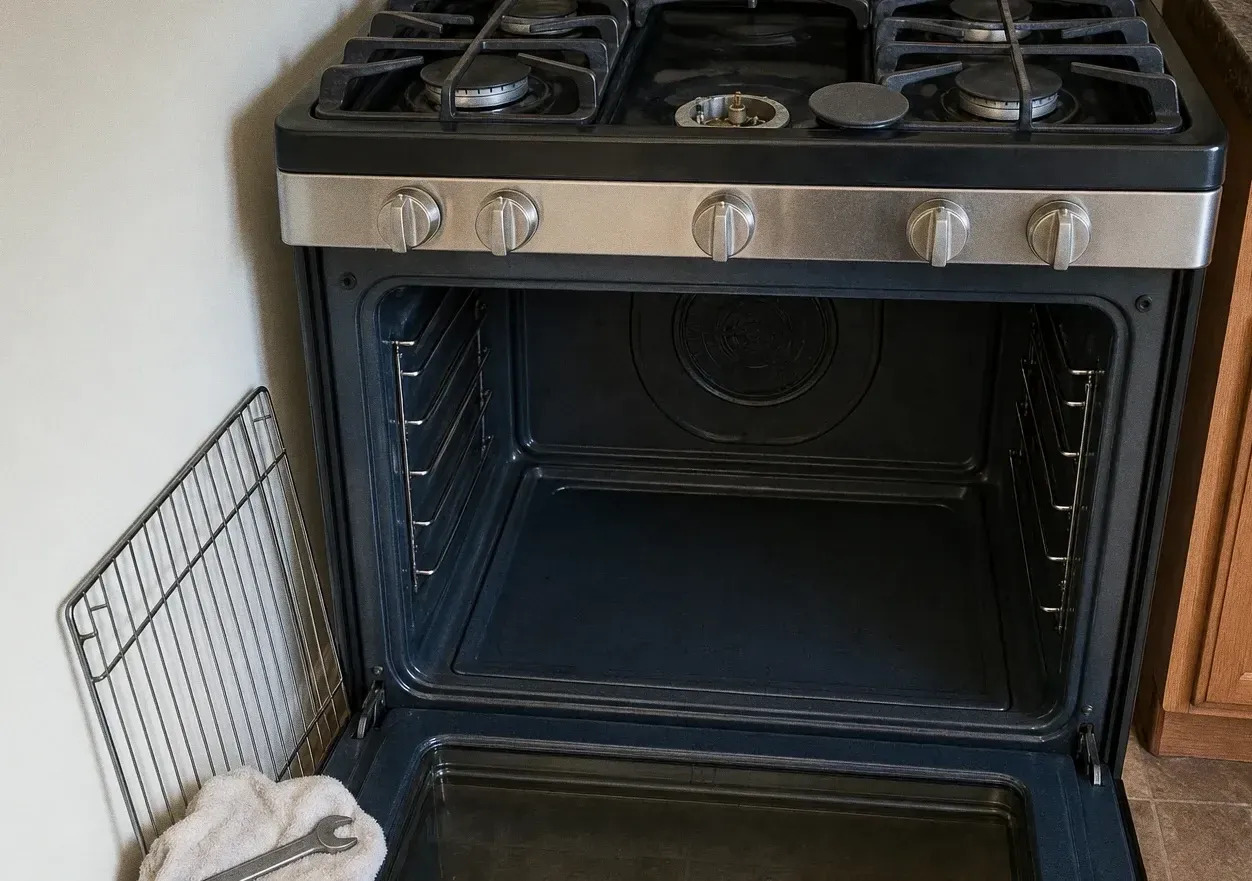
The cycle ended last night. This morning there is a code where the clock should be, the Wolf door has not released, and the second cavity above it is behaving perfectly normally — which is either reassuring or misleading, depending entirely on what that code turns out to mean.
Before you call it a fault, wait properly
Nothing about a shut door straight after a clean run is abnormal. The lock is held by the control, not by the heat, and the control keeps it set until it reads the cavity below the temperature it treats as safe. That reading arrives a long way after the heating stops, so the door stays closed well into the period when the appliance appears to be finished.
The tell that everything is progressing normally is the cooling fan. It commonly continues after the display has returned to the time of day, and a running fan means the electronics are alive and the sequence is still working through. In the compact kitchens off Wellesley Square, where the appliance sits a few feet from where everybody is, that fan gets blamed for the problem when it is actually the evidence against one.
Paired installations offer something better than patience: a comparison. If one cavity is shut and the other opens, powers up and heats normally, the supply, the breaker and everything shared between the two are eliminated already, and the fault is confined to one half of the appliance. Establish that before doing anything else — it removes a third of the candidates for free.
Patience has run out when the door and its trim have reached room temperature and the lock is still engaged. An appliance that has gone cold and stayed shut is telling you one of two things: the control is misreading the cavity, or it cannot move the mechanism. A further hour improves neither.
Locked, or locked and dead? They are different faults
Two situations look identical from across the room and are nothing like each other. In the first, the appliance is awake and simply will not release: panel lit, presses producing a response, fan possibly still turning. In the second, the panel is dark and the door is shut for the dull reason that nothing has the power to open it.
Find the breaker before assuming the worst. In a double installation one circuit may serve both cavities or each may have its own, so establish which arrangement you have; in the Cambridge conversions we cover, the panel often sits in a hallway shared with other units and is badly labelled, which is worth sorting out before an appointment rather than during one. Switch off, allow a couple of minutes, switch back on. That is a test of whether the control recovers, and nothing more.
When it does not recover, the thermal fuse is the likely reason. It exists to open the supply permanently if the compartment exceeds the temperature the design permits, and realistically only the clean cycle ever tests it. It is a one-shot part — no reset, no recovery — and replacing it without asking why it opened simply queues the same morning up again.
Repeated breaker resets are pointless at best. If the fuse has gone, the breaker has nothing to do with it. If the breaker is what keeps tripping, something is drawing current it should not be, and forcing power back into that fault does real damage to the wiring around it.
What the latch is and how it fails
The door is held by a bolt driven across it by a small motor, with a switch reporting the position that bolt has reached. The control asks, the switch answers, and the appliance only unlocks when the answer matches the question. Almost every version of this fault is a breakdown in that conversation rather than a broken piece of metal.
There are two of them. The motor may never run at all, because the control is not driving it or a winding has failed, in which case the bolt does not move. Or the bolt moves exactly as it should and the switch never confirms it, in which case the control assumes the worst and keeps the door shut out of caution. A kitchen cannot tell these apart; a meter can, in about a minute.
Then there is the mechanical version. During the cycle the door, its liner and the frame all expand well beyond anything a bake puts them through, and they contract again as the appliance cools. A bolt with marginal clearance can catch on the way back, especially with flakes of carbonised deposit shed into its path during the run.
That is as far as looking gets you. The mechanism lives inside the top of the appliance among mains wiring and hot sheet metal, and on a paired installation the door itself is heavier than it appears. The rest is a Wolf Oven Repair job.
The code on the display, read honestly
A code reports an observation. It is the control describing what it saw — a lock that did not reach position, a sensor reading it cannot believe, a temperature outside the range allowed for the state the appliance is in — and it names none of the components capable of producing that observation. Reading it as a part number is the commonest mistake made with these.
What separates a nuisance from a fault is what the code does next. One that clears on a power cycle and does not come back through an ordinary bake describes something that happened once. One that reappears the moment power is restored describes a condition still present in the appliance, and that is the one to act on quickly.
Record it before clearing it, exactly as shown. It costs nothing at the time and it is the single most useful thing anybody can hand a technician — particularly on paired installations, where knowing which cavity produced it narrows the wiring involved straight away. A remembered approximation is worth very little.
The manual alternative
An honest word about the cycle itself: it is the most demanding thing the appliance ever does, and it finds every component already close to the end. Elements open, relays that carry the heating load work harder than at any other time, and seals come back stiffer than they went. None of that makes the feature bad. It makes it a test as well as a cleaning method.
So run it on your own terms. Not in the week before the appliance is needed for something that matters, which in Wellesley Hills and Wellesley Farms usually means not in the run-up to whatever the household cooks for. Give any failure it uncovers room to be dealt with before it becomes urgent.
Between times, hand cleaning is a real alternative rather than a fallback. A cavity wiped while it is still warm, often enough, never builds the deposit that makes a full cycle necessary — and when the cycle is eventually run there is far less in there for it to do. Households with two cavities frequently end up cleaning the everyday one by hand and saving the cycle for the one that does the heavy work.
What a technician can do that you cannot
Three symptoms are worth a call and should not be sat on: any smell of electrics burning, a breaker that refuses to stay in after a reset, and a door still held shut once the appliance has gone cold for hours. Switch the circuit off first and make the call second.
Do not force it. The bolt is not designed to be beaten by hand, and the force that eventually shifts it lands on the hinges, the strike plate and the glass instead — which is how a latch fault becomes a door and hinge job. On a heavy paired door that is an expensive conversion of a small problem into a large one.
What a technician brings is measurement: testing the fuse for continuity, watching for drive voltage at the latch, reading current draw while the mechanism is asked to move, checking that the switch changes state, and comparing the cavity sensor against an independent reading. Our service call is $95. Where the finding is a door hinge, glass or seal, that work has run $210–$960; a control board or touch panel is $510–$1,590; thermostat or sensor calibration is $130–$660. Our coverage runs to Wellesley Hills, Wellesley Square and Cambridge. The number to ring sits at the head of this page, with the booking link immediately beside it.
Still asked
What is a thermal fuse and why did it blow?
It is a small one-shot device in the supply that opens for good once the compartment passes the temperature the design allows, protecting everything downstream of it. Nothing resets it; it is a replacement part. It typically goes during a clean cycle because that is the only time the appliance runs that hot, and the reasons behind it are usually a stopped cooling fan, blocked ventilation around the installation, or a control that carried on heating.
The oven opened but now will not heat — are the two related?
Yes, in the sense that one run produced both. Anything marginal inside is worked hardest during a clean cycle, so an element or a switching relay near the end of its service life often gives out then, while the shut door is taking all the attention. Report the two together: a door fault plus a heating fault from the same night points a diagnosis in a much narrower direction than either symptom alone.
The display shows a code — does that tell me which part failed?
No. A code records what the control observed, in the control's own language: a position not reached, a reading it cannot reconcile, a temperature where it should not be. Several different components can produce the same observation, so a code narrows the search without ending it. What it does do is separate a one-off from a live fault — note whether it returns as soon as power is restored, and tell us either way.