Wolf Range Repair
How Long a Wolf Range Self-Clean Takes, Model by Model
A Wolf self-clean takes four hours on current DF dual fuel ranges and M Series ovens, and that time is fixed. Legacy DF models and E Series ovens can be set to 3 or 4 hours, and all-gas Wolf ranges have no self-clean at all.
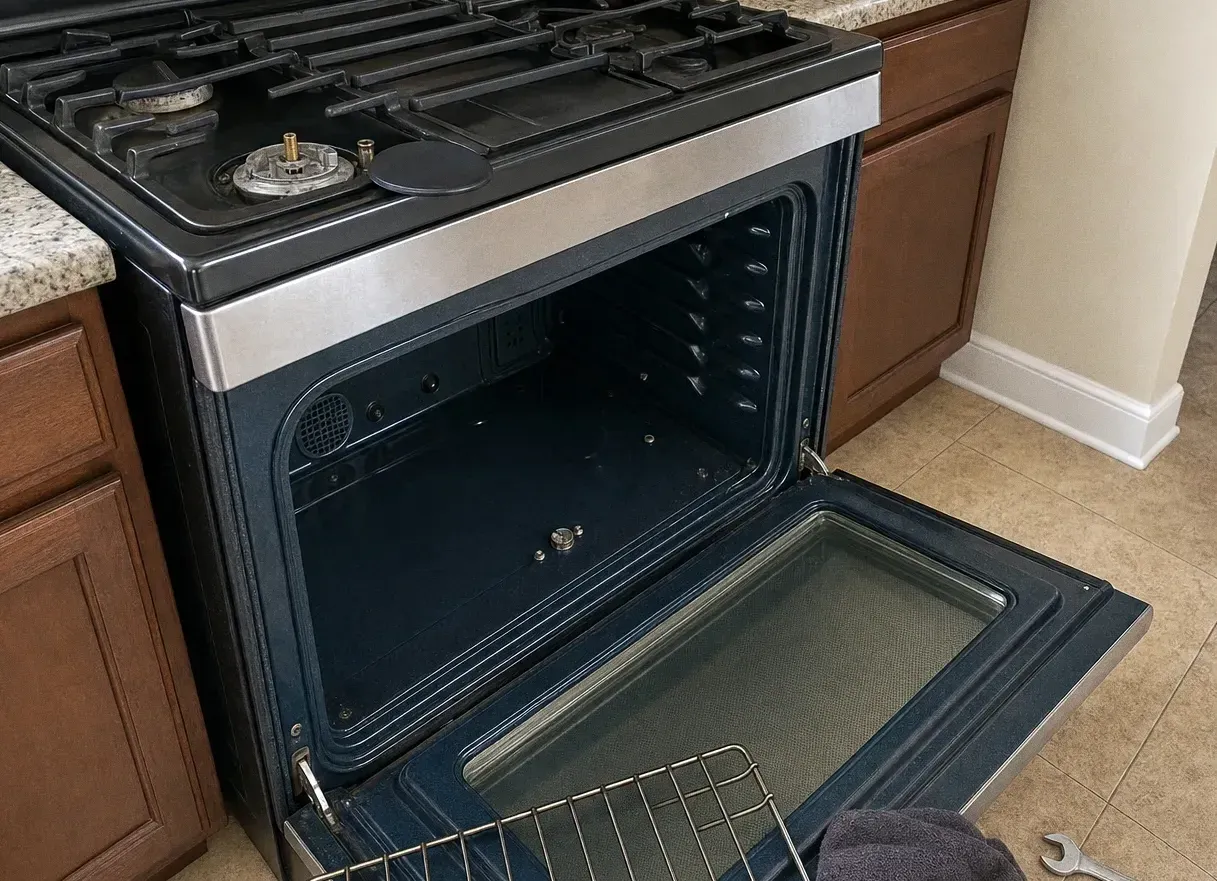
A Wolf self-clean runs four hours on the current dual fuel ranges, the DF3050, DF3650, DF4850 and DF6050, and on M Series wall ovens; on those models the length is fixed. Older dual fuel ranges from the DF30, DF36, DF48 and DF60 line let you pick 3 or 4 hours, and E Series wall ovens can be set anywhere from 3 to 4 hours. An all-gas Wolf range has no clean cycle at all: its oven has no door lock and never gets near the roughly 900°F that real self-cleaning needs.
Either way, the oven is out of use for the whole cycle, because the door stays latched until the cavity cools. Treat it as an evening job, not something to squeeze in before dinner.
Cycle length for each Wolf model
The timing breaks down like this:
- Current dual fuel ranges (DF3050, DF3650, DF4850, DF6050): 4 hours, not adjustable.
- M Series wall ovens: 4 hours, not adjustable.
- Legacy dual fuel ranges (DF30, DF36, DF48, DF60): 3 or 4 hours, your choice.
- E Series wall ovens: adjustable from 3 to 4 hours.
- All-gas Wolf ranges: no self-clean function.
On the legacy ranges Wolf spells out how the shorter setting is spent: two hours of cleaning heat, then one hour of cooling behind the latched door. So without the cool-down, the actual burn-off on that setting is about two hours.
Where you have a choice, match the setting to the mess. A cavity wiped every few weeks, with only a thin film of splatter, will come clean on the shorter cycle. Save the full four hours for drips baked on over a season of roasting. The long setting on a clean oven only puts the enamel and door gasket through extra heat.
What happens inside the oven during those hours
Self-clean uses heat, not chemistry. The elements drive the cavity to about 900°F, where grease and food residue turn into a pale, dry ash. Most of the clock goes to climbing to that heat, holding it, then cooling back down while the lock stays engaged.
Some smoke and a burnt or oily smell are normal, and Wolf says so in its own guidance. The usual source is food or grease left in the oven, and grease on the broil element at the top of the cavity is easy to miss. Run the hood for the whole cycle and crack a window; if the hood cannot keep up, our Wolf range hood repair page explains what we check.
The steady whir is the cooling fan protecting the controls and outer panels. It often runs on for a while after the cycle ends, which is expected.
Getting the oven ready before you press Clean
Most rough self-clean experiences trace back to skipped preparation. Take out pans, foil, a pizza stone and the broiler pan, and the racks too unless your use and care guide says they can stay.
Next, deal with heavy spills by hand. For M Series ovens, Wolf recommends lifting baked-on food with a razor blade, then washing the cavity with soap and water, because leftover spray oven cleaner can etch the porcelain once heated. Wipe the broil element and the cavity ceiling as well, since grease hiding there produces most of the smoke.
If you also have an L Series wall oven, check the bake stone. On units with a serial number below 16000000, a STONE, Bake Stone In or No Bake Stone message during self-clean means the bake stone heating element is still plugged in. Pull it straight out toward you; the clean will not start with it in place.
Pet birds are highly sensitive to self-clean fumes, so move them far from the kitchen, and keep towels, mitts and plastic utensils clear of the oven vent.
When the cycle stops early or the door stays locked
Wolf advises against switching an oven off mid-clean, since an incomplete cycle can cause damage. If you cancel anyway, the lock holds until the cavity cools, which may take an hour or more. A door still locked long after a normal cycle is a separate problem, covered in our guide to a Wolf door that will not open after self-clean.
Error codes during a clean nearly always point to heat or the lock. On M Series ovens, 5021 or 5022 means the cavity overheated during self-clean and 5431 or 5432 means it heated too slowly, while Lower Door Open or Unlocked in Clean is lock-related. Legacy E Series ovens show 04 x 1 when the door lock inputs are invalid for a clean, 04 x 2 when the latch motor timed out, and 07 x 38 for a latch circuit fault such as oxidized contacts. On the 24-inch SO24, E46 and E48 mean the cavity ran hot in the second phase of the clean. For each one, cut the oven’s breaker for 30 seconds, restore it and try again; a code that returns needs a technician.
Two things look like faults and are not. On an M Series double oven, an error when you try the second cavity mid-clean just means one oven is locked out while the other cleans. And patchy results can be electrical: Wolf dual fuel ranges and L, E and M Series wall ovens need a dedicated 240/208 V circuit, and below 240 volts the oven may not reach its roughly 900°F target in time. Larger condo buildings are often fed 208 volts, so in a Cambridge high-rise unit rule this out before blaming a part.
After the cycle: ash, fine lines and when to call
Once the oven is cool and unlocked, wipe the ash out with a damp cloth. White spots that remain are usually mineral or salt deposits that heat cannot break down; a damp non-abrasive pad lifts them.
Wolf notes that porcelain interiors expand and contract with heat, and self-clean especially can leave fine lines, small chips or a cloudy look, more visible in a colored cavity. That is cosmetic.
Call when a code survives a breaker reset, when the oven heats poorly after a clean, or when the door no longer sits square against its seal. Self-clean is the hardest workout an oven gets, so it often exposes a tired latch, sensor or gasket. We service Wolf ranges across Wellesley Farms, Wellesley Hills, Wellesley Square and Cambridge. The visit is a flat $95 covering the trip and a full diagnosis, credited toward the work if you go ahead. Typical ranges: door hinge, glass or seal $210–$960, oven thermostat or sensor calibration $130–$660, control board or touch panel $510–$1,590, with the firm price after diagnosis. Call (781) 371-8990.
Still asked
What does the self-clean cycle actually do inside a Wolf oven?
It heats the empty cavity to roughly 900°F so that grease and food residue break down into a dry grey ash. The door locks for the hot part of the cycle and stays locked while the oven cools. Afterwards you wipe the ash out with a damp cloth. No chemicals are involved, which is why spray cleaner residue should be washed off before you start.
Is a self-cleaning oven dangerous to run at home?
Not when it is used as intended, with the door latched, the hood running and a window open. Expect smoke and a burnt smell if residue was left inside. The real caution is pet birds, which are very sensitive to the fumes, so move them well away from the kitchen or out of the house until the cycle ends and the room has aired out.
I left the racks in during self-clean. Are they ruined?
Usually not, but chrome-finish racks often come out dull or discolored and may drag on their supports. Wash and dry them, then rub a little cooking oil along the edges where they slide. Check your use and care guide before the next clean; unless it says your racks are made to stay in, take them out first.
Why does my Wolf gas range have no self-clean setting?
Because a Wolf all-gas range is not built for one. Its oven has no door lock and does not reach the 900°F-plus heat a true self-clean depends on. Every Wolf electric oven, including the oven in a dual fuel range, does offer self-clean. On the gas oven, clean by hand with a non-abrasive cleaner and rinse off any residue.
Can I cancel a Wolf self-clean partway through?
You can, but Wolf advises against it, because stopping before the cycle completes can cause damage. A canceled clean also leaves the door locked until the cavity has cooled, which may take an hour or more. If you need the oven that day, start the clean early or choose another day rather than interrupting it.